7th August 2019
On 30th July, Sue took part in one of the more adventurous activities organised by her U3A Experience Group. It was a foul day, windy, with frequent showers, and it didn’t end well for her. A small group of intrepid members travelled to Irchester Country Park, near Northampton, for a day of tree climbing, swinging like monkeys on ropes, and whizzing down zip wires. It sounded like a fantastic activity, one I would have gladly participated in myself, but instead, I spent the day cleaning out the pool, cutting back the ivy creeping up the garage wall, and picking the last of the broad beans. Besides, I’m not a member of the U3A!
At first, all went well, despite the occasional need to take shelter from the rain, which made the treetop course trickier than usual. However, towards the end of the day, Sue may have become a little too exuberant and crashed heavily at the end of one zip-wire run. When she returned home, she looked decidedly pale and was clearly sore down one side. She took to bed earlier than usual that evening, dosed up with anti-inflammatories and paracetamol.
It wasn’t long before I, too, ‘hit the pillow’. That night, I had to collect Jamie from Desborough at 1:30 am before heading to Stansted Airport for our flight to Ukraine. This was a father-and-son trip, with the main purpose of visiting the Chernobyl nuclear disaster site.
When Jamie suggested travelling to Ukraine, I watched a documentary and a mini-series about the 26th April 1986 disaster at Reactor No. 4 of the Chernobyl Nuclear Power Plant and the nearby city of Pripyat. I thought I remembered the incident well, but after watching the series, I realised just how close the world came to catastrophe. It’s a definite ‘must-do’ tour for anyone visiting this former communist state, a sobering and salutary lesson on the past and perhaps also the present ideology and doctrine of the Russian state. Many myths have since obscured the facts surrounding the cause and aftermath of the Reactor No. 4 meltdown, so it’s essential to keep an open and sceptical mind about all the ‘facts’.
Today, the Chornobyl Nuclear Power Plant is no longer operational. All reactors have been shut down, two of them due to severe accidents (Units 4 and 2). Unit 1 continued operating until 1996 despite sustaining permanent core damage from a partial fuel meltdown in 1982, and Unit 3, the twin of the ill-fated Unit 4, remained active until 2000. All reactors have now been defuelled, though the spent fuel remains on site, stored in concrete bunkers adjacent to the sarcophagus covering Unit 4.
After the nightmare of my last early morning journey to Stansted, I had my fingers firmly crossed that the A14 wouldn’t be closed overnight again with another nonsensical diversion. It was closed, but this time, the diversion actually made sense, so we lost very little time. Before long, we were enjoying a full English breakfast in the departure lounge, waiting for our 6:40 am flight to Kyiv.
We landed at Boryspil International Airport at noon, and after locating our pre-booked taxi, we were soon racing through Kyiv’s traffic to the Adria Hotel on R. Okipnoi Street. While checking in, I got chatting with a couple who had been on our flight. They, too, were visiting Chernobyl the next day and asked how we were getting to the coach pick-up point. I told them I’d arranged for our taxi driver to collect us in the morning and offered to share the ride with them. They gratefully accepted.

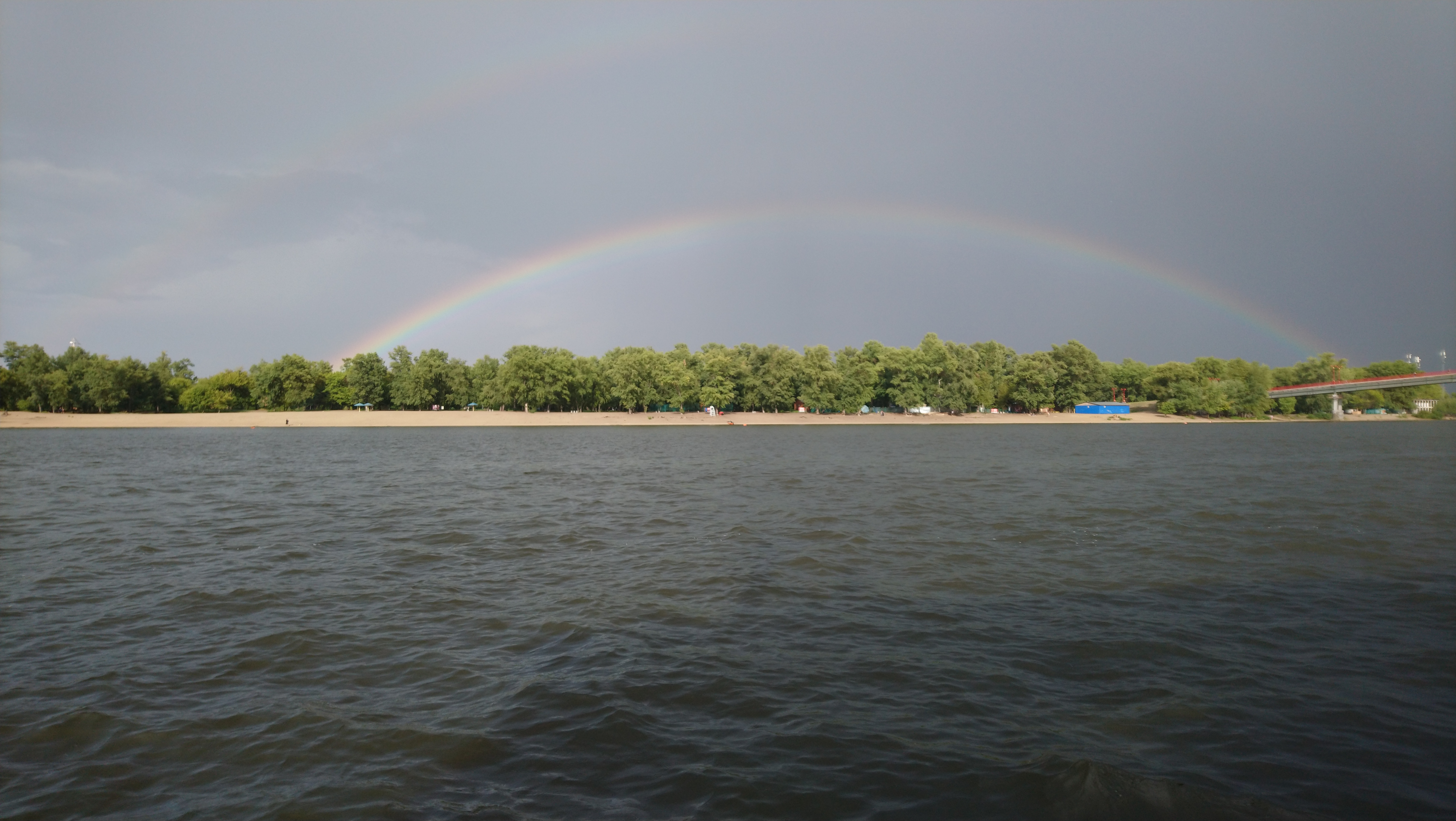
After unwinding in our room, we set off to explore the local area before eventually making our way down to the Dnipro River. There, we spent a relaxing late afternoon at a floating bar, enjoying the warm weather while watching the river traffic and the cityscape unfold before us.
Our hotel was located on the opposite bank of the river from Kyiv’s older, more touristy district. It was part of a hotel complex conveniently close to a Metro station. The surrounding area was bustling, with a day and night market nearby, numerous shopping malls, and plenty of restaurants.
When crossing the road, it was best to use the designated crossing points, as there were few gaps in the constant stream of traffic. That said, the drivers were noticeably more civilised than those I’ve encountered in the Far East; they would stop if you stepped out in front of them. Still, it was best not to push your luck too far!

That evening, we dined at a rather disappointing restaurant. Initially, we had spotted a place with a balcony overlooking the large roundabout near our hotel. However, after climbing numerous stairs to reach it, we discovered that a very elegant wedding reception was in full swing. Tempting as it was to gate-crash for a free meal, I doubted my Russian would stand up to close scrutiny!
Looking for an alternative, we asked a secretary seated in an office on the same floor if she could recommend another restaurant. She kindly led us along a corridor to the other side of the building, where, sure enough, we found another dining establishment.
 Inside, there was just one other couple, selecting items from a buffet cabinet containing around ten different dishes. We stood behind them, listening as they enquired in Ukrainian about the various options. After ten minutes of patient waiting, during which they continued chatting without a single morsel making it onto their plates, Jamie and I decided to sit down at a table and rest our legs.
Twenty minutes later, they finally sat down at the table next to ours, each with just three items on their plates. By this point, we had realised that this was a vegetarian restaurant, but having already invested so much time in waiting, we were reluctant to leave. I’ve spent time with Phil and Joan in Italy, both vegetarians, and I know from experience that, despite the absence of meat, vegetarian food can be vibrant, full of flavour, and surprisingly satisfying. However, this array of unknown dishes looked drab, lifeless, and mulched. Still, the true test was in the eating.
The young lad behind the counter spoke perfect English and helpfully described everything we pointed to, so it wasn’t long before we sat down with our selection, eager to have our taste buds awakened. Unfortunately, the food was bland, reminiscent of baby purée. The only item remotely worthy of note was a cabbage burger, which, unsurprisingly, tasted of cabbage. But why?
As we left, the couple were still picking at their meals and had now switched to speaking in English. Had they overheard our earlier impatience and deliberately prolonged their decision-making as a form of silent retribution? We would have to be more careful; clearly, the locals could understand more than we had assumed! I also noticed that they, like the few other diners who had since arrived, appeared painfully thin and pale. The last laugh may well be on us, but I suspect it will be a long time coming.
The Journey to Chernobyl: The following morning, we met the couple from check-in as we emerged from the Adria Hotel at 6:15 am, sipping coffee in the early light. Our taxi arrived punctually, and together, we made our way through the relatively quiet streets to the Dnipro Hotel in central Kyiv, the designated meeting point for our tour. After confirming we were in the right place, we headed into the hotel’s restaurant and ordered breakfast.
By 7:30 am, with no sign of our food, the kitchen hastily boxed it up for us so we wouldn’t miss our tour. Jamie and I boarded the minibus, and ravenous from the night before, I eagerly opened my breakfast box. Inside, I was greeted by a congealed mess of fried egg, bacon, potato cake, and what I thought was cheese. It wasn’t a pleasant sight, but I was hungry, and at least, unlike the Ukrainian ‘baby food’ from the previous night, this meal still required chewing!
Our departure was delayed as one couple had failed to turn up. This, however, turned out to be a stroke of luck for our taxi companions. When they attempted to board the bus, they realised, to their horror, that they had booked a different tour with a different meeting point entirely. I had told them the name of our tour and hotel the previous day, so why hadn’t they checked their paperwork in the meantime? Unlike us, they had come to Kyiv solely for the Chernobyl tour and were due to fly home the following day. Unable to get hold of their own tour company, they had no choice but to buy last-minute spots on ours; luckily, two no-shows meant there was space. I wonder if the reverse had happened to the missing couple?
Into the Exclusion Zone: A little later than planned, we set off on the two-hour drive to the Chernobyl Exclusion Zone. The city’s endless rows of tired, grey concrete residential tower blocks soon gave way to flat, heavily forested countryside punctuated by small villages. Whether built from concrete, brick, or wood, most houses followed a similar design, each with its obligatory animal pens and essential vegetable patch on either side. Traffic was sparse, a fact that, given our destination, didn’t surprise me in the slightest.
Our first stop was at the 30km checkpoint on the edge of the outer Exclusion Zone. Here, we had to present our passports and official passes before being issued with small radiation monitoring devices, which we hung around our necks. Once cleared, we re-boarded our transport and continued along the eerily deserted road towards the city of Chernobyl.

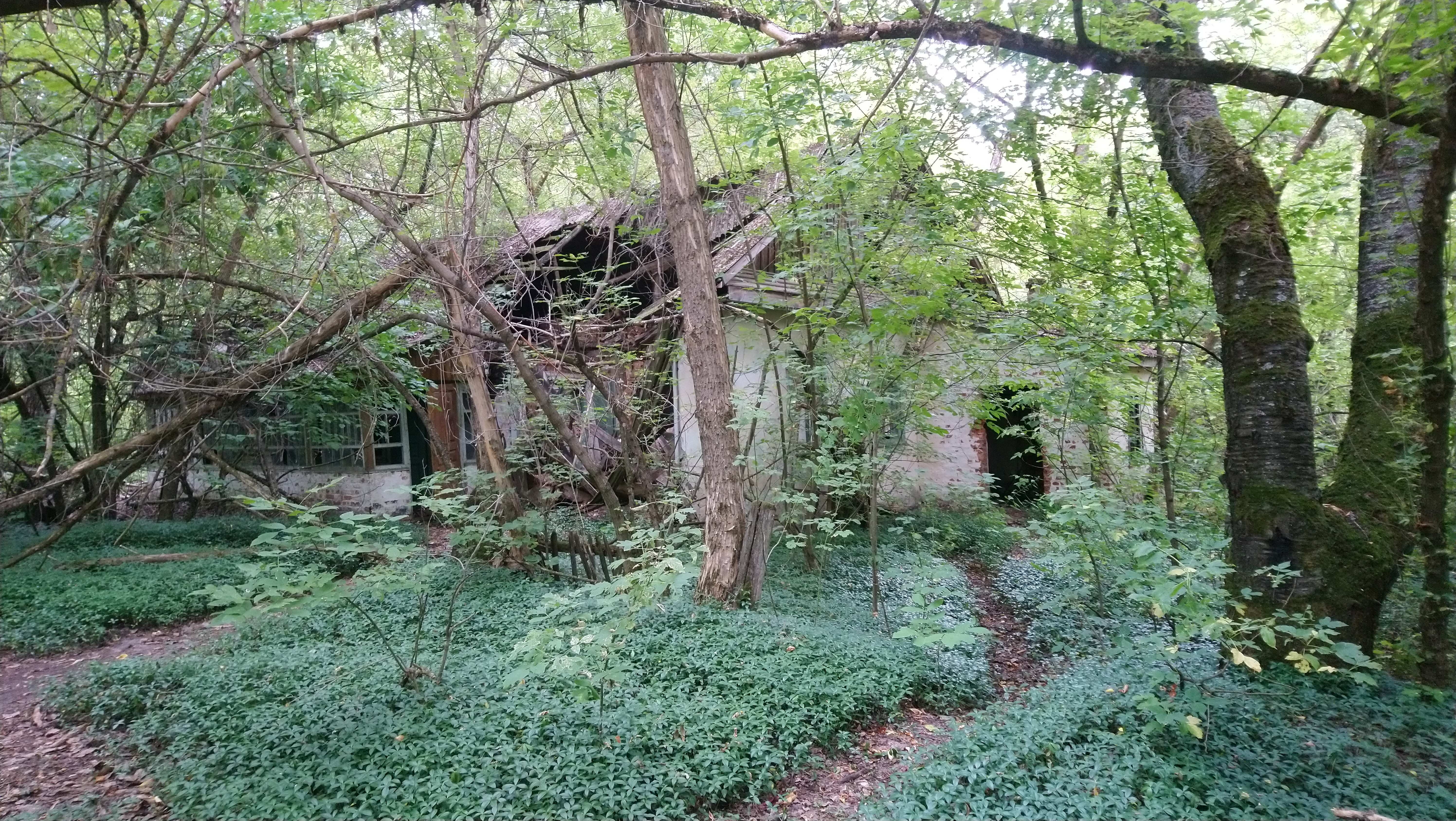
After about fifteen minutes, we pulled over to the side of the road and disembarked. Our guide, Alex, explained that we were about to explore one of the abandoned villages. From the roadside, we could just make out a few structures through the dense tangle of trees and undergrowth.
We followed a narrow path into the forest, a path that had once been the village’s main street. Like so many principal roads in this part of Ukraine, it had been named Lenin Street. This was one of 167 abandoned communities within the Exclusion Zone, but this one was particularly noteworthy due to its relative wealth. Many of its buildings were made of brick, and they had withstood the passage of 33 years better than most. The village had been repurposed in the aftermath of the disaster, first as a base for the liquidators and later by the army.
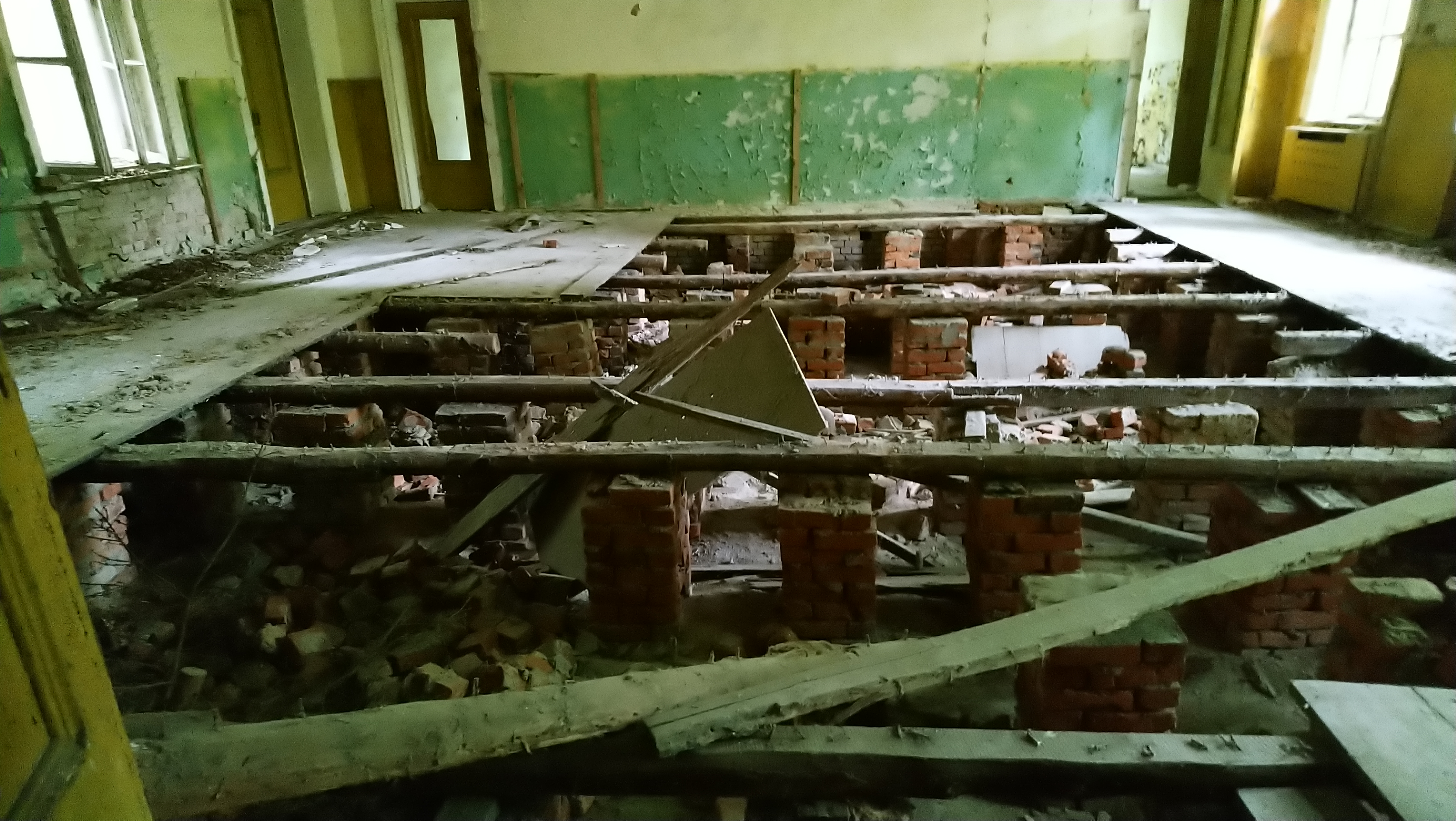
We first entered the administration building, stepping carefully to avoid disturbing debris and raising dust. Much of the wooden flooring had been looted, along with valuable items from the surrounding houses, furniture, electrical goods, and anything else of worth, all taken in the chaotic days following the disaster.
Everything here was radioactive, as confirmed by the rising numbers on our Geiger counters. Those who looted and sold these contaminated items on the black market were certainly tempting fate. Many likely suffered early deaths as a result. The unfortunate buyers, unaware of the origins of their purchases, would have had no idea of the invisible danger they carried into their homes.
Most of the wooden buildings in the Exclusion Zone had been bulldozed, buried under layers of earth, and marked with bright yellow radioactive warning signs. But in this village, one remained standing, and we stepped inside.
It was a poignant experience to explore the small, one-room structure. Signs of hurried abandonment were everywhere; the bed remained untouched, and the everyday paraphernalia of Ukrainian life sat frozen in time. The villagers had been given just two hours to pack enough clothing for three days, reassured that they would soon return.
They never did.

As I wandered back to the minibus, I spotted the first of many wild dogs, now the sole inhabitants of these lost settlements. Like the others I would later encounter, this one seemed unbothered by our presence, more focused on sniffing through the rubble in search of long-gone food.
Our journey continued for another fifteen minutes until we reached the town of Chernobyl itself. Unlike the abandoned villages, Chernobyl is in far better condition. Though no one permanently resides there, it remains a functional site, home to those overseeing the security and ongoing reclamation efforts in the Exclusion Zone.
For the particularly daring, it is even possible to stay overnight by renting one of the apartments. However, beyond the eerie atmosphere, the main points of interest here are a large, flat concrete map of the Exclusion Zone, marked with small steel cups representing each of the abandoned settlements, where candles are lit every 21st April, and an avenue of signs displaying the names of the defunct communities, a solemn tribute to what was lost.

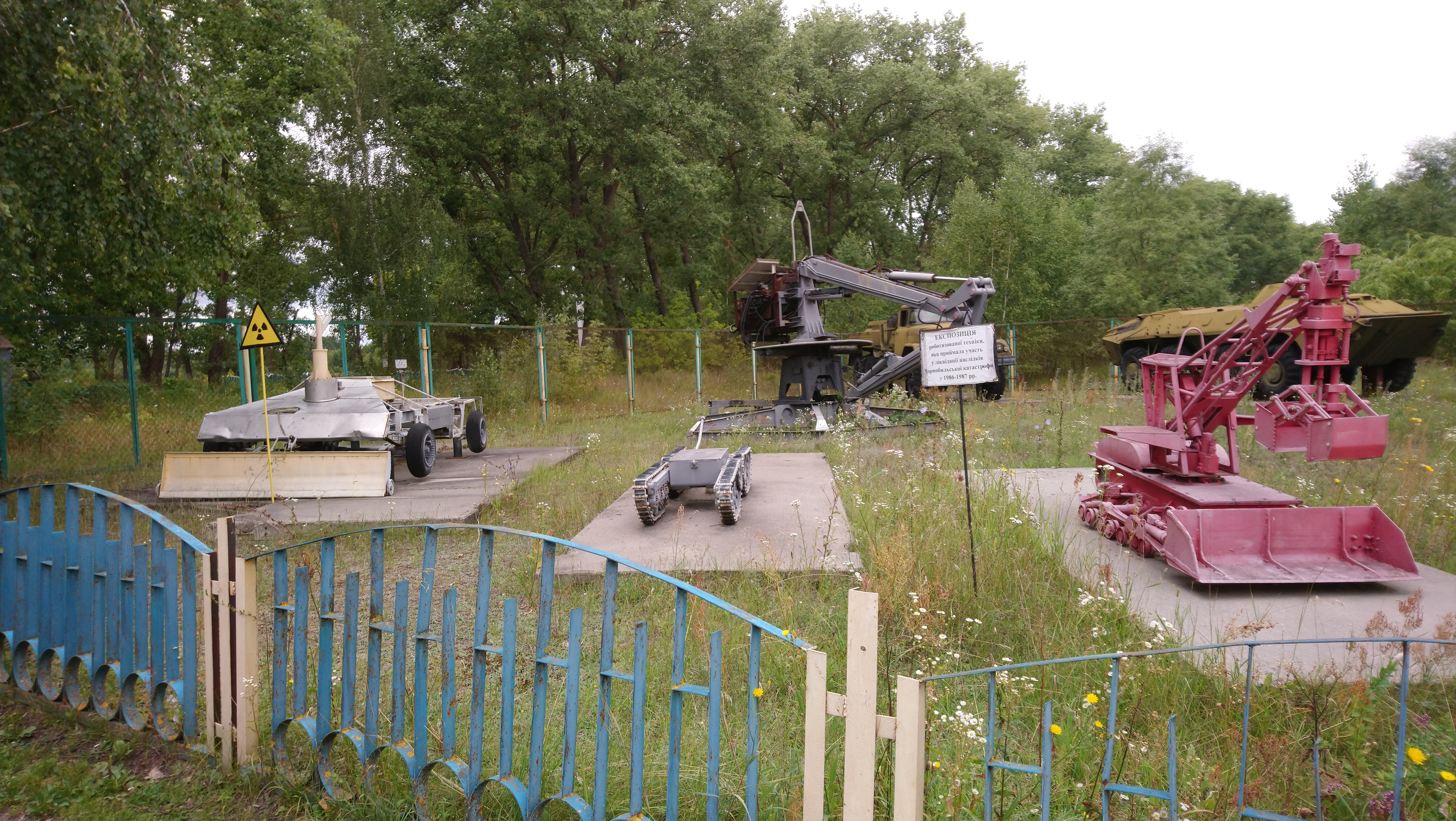
 On the outskirts of town, we stopped briefly to photograph some of the machinery used by the liquidators in their desperate attempt to clear the 100 tons of lethally radioactive material from the reactor’s roof. These relics remain highly radioactive, and only certain parts were deemed safe enough to be displayed. No doubt, the rest were buried in the deep forest, entombed in lead and concrete alongside the countless other vehicles and tools sacrificed to the disaster.
The tragedy was compounded by the fact that none of the equipment we were looking at had actually worked; radiation had instantly fried their electronics. In the end, the impossible task fell to 5,000 soldiers, each given just 40 to 90 seconds to complete their part before retreating from the deadly exposure.
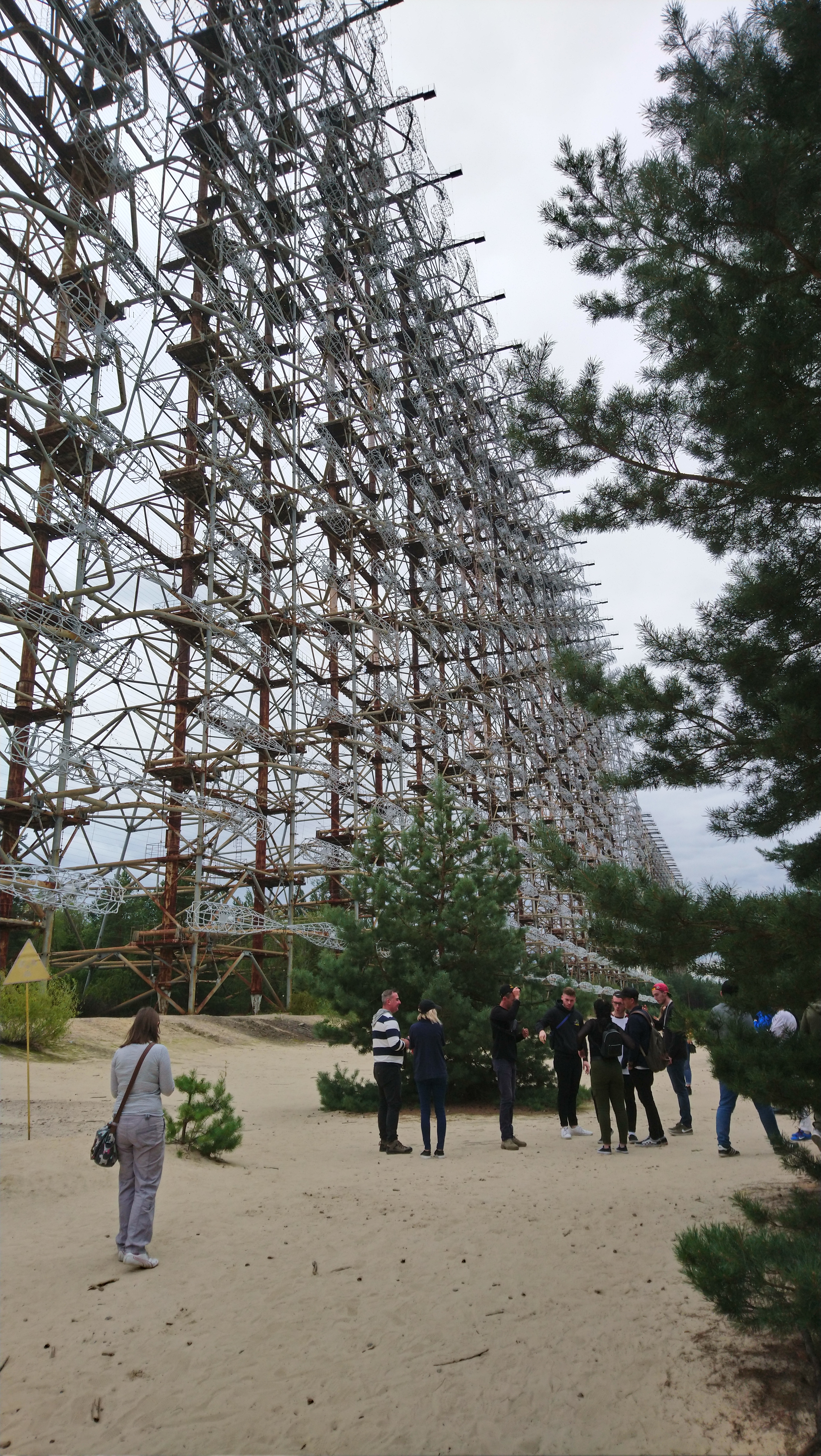
Our next stop was a relic of the Cold War, an imposing testament to Russian distrust and aggression. A twenty-minute drive down a narrow forest lane brought us to the towering structure of the Duga Radar. Even after three decades of unchecked forest growth, it dominated the landscape, visible from miles away.
This over-the-horizon early warning system was the Soviet Union’s attempt at missile detection, cheaper than the American and European satellite systems, yet deeply flawed. It could detect the launch of multiple missiles but failed to register a single one. A costly folly, perhaps, but one that remained operational until 1989, three years after the Chornobyl disaster. I wonder if the Americans knew of its limitations.

 Returning to the road leading to the power plant, we stopped at the 10km checkpoint for passport and pass checks. We also had to step into a radiation scanner, fingers crossed. Thankfully, the little exit gate clicked open; hopefully, it was a good sign.
The next leg of our journey took us through yet more dense forest until, rounding a sharp bend along what appeared to be a river, the power plant and its containment sarcophagus came into view. We stopped about half a mile away for photographs. Ironically, I thought, this is close enough, a clear view, great photos, job done!
Boarding the minibus, I expected a quick U-turn and exit. Instead, to my surprise, we continued forward, sweeping past the front of Unit 1, then alongside Units 2 and 3, before coming to a halt outside the sarcophagus covering Unit 4. As we stepped off the bus, a train with two wagons emerged from behind two massive concrete structures beside the reactor. It was accompanied by a group of soldiers and stopped just a few metres away from us.


“Only take photos of the reactor,” Alex warned us. “Photograph the concrete boxes, the train, or the soldiers, and your camera will be confiscated.” The wagons, he explained, contained spent fuel rods, while the massive concrete structures were storage facilities for them.
I snapped a few more shots of the infamous reactor and wasn’t at all disappointed when we were asked to return to the relative safety of our bus.
A short drive brought us to a large building on the outskirts of Pripyat, where we were to have lunch. Before entering, we stepped through another radiation scanner, identical to the one at the 10km checkpoint. Once cleared, we joined the queue for what I assumed was a typical Ukrainian four-course meal.
Alex chose to sit with Jamie and me, and we chatted throughout. The food was a marked improvement on what we had been served so far, surprisingly tasty and filling. Our guide was particularly enthusiastic about the borsch, launching into a detailed explanation of how to make the perfect version of the dish.

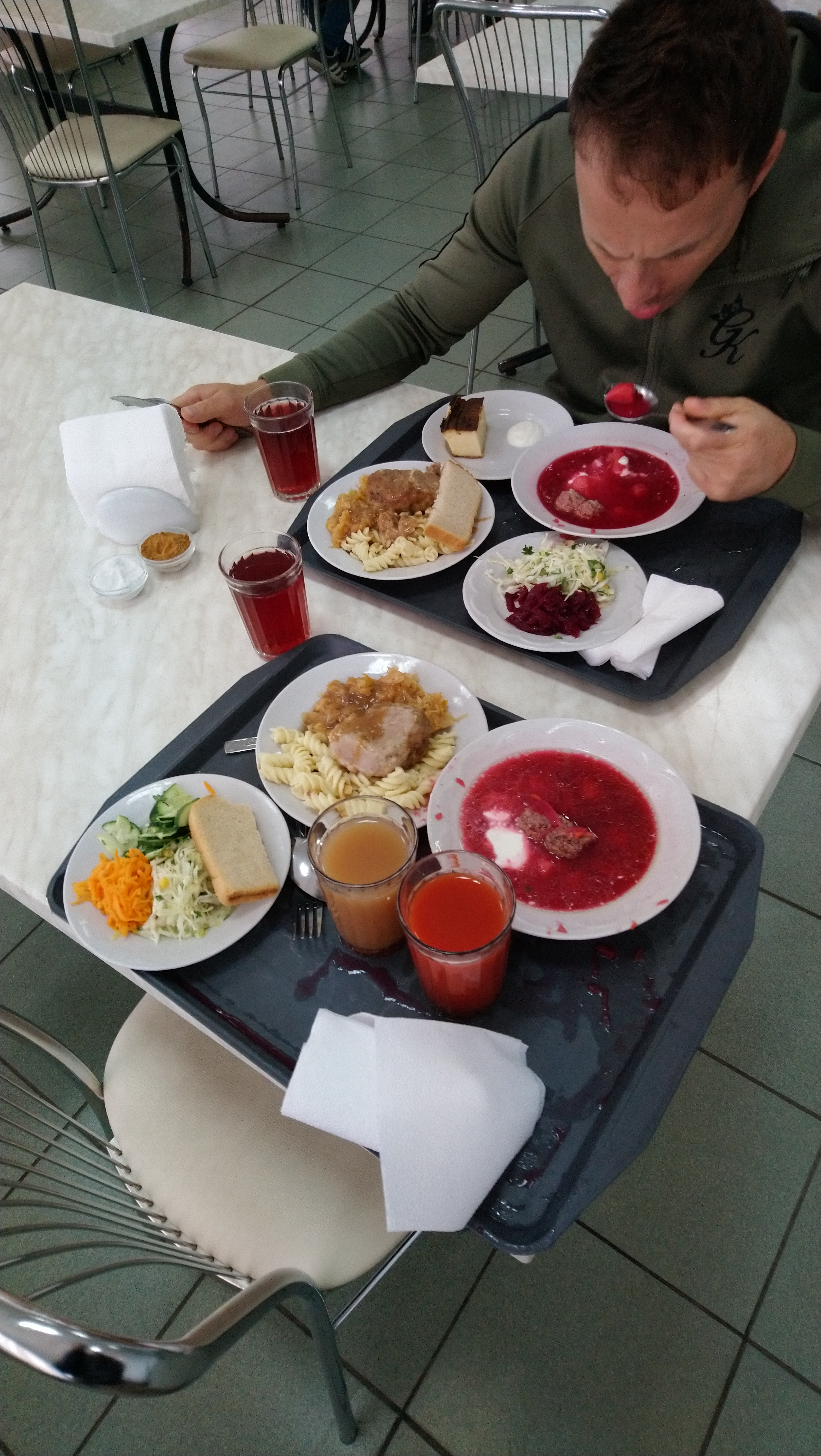 As expected, Alex was incredibly knowledgeable about the disaster and the Exclusion Zone. What surprised me, however, was his equally impressive understanding of British history and politics. Your average Ukrainian, it seems, is far more politically aware than most Brits, and their views on Russia and its current leadership are resolute, if not fierce. Given that the Russian army sits just 30km north of Chernobyl and that Soviet doctrine was directly responsible for the catastrophe that brought us here, their stance is entirely understandable.
With stomachs now full (hopefully not glowing), we drove into the heart of Pripyat.
Our first stop was the hospital, a sobering start. It was here that the worst casualties were first treated before being transferred to Moscow’s Hospital No. 6, where many of the liquidators later died. No one truly knows how many lives were lost, though the official Russian figure, laughably, remains at just 31.
Pripyat was built to serve the nuclear power plant. It was a modern city, home to nearly 50,000 residents before the disaster. Even after decades of abandonment and nature reclaiming the streets, it’s clear that it must have been a thriving place, offering the best of what Soviet society could provide.
The hospital, however, is in a sorrowful state. Long, dark corridors are strewn with rubble. Rusting cots sit in six-bed cubicles, surrounded by scattered medical forms and walls of peeling paint. The atmosphere is both tragic and eerie. A single gas mask draped over a stairway bannister tells its own silent story. Unlike so many other relics scavenged from the zone, it remains untouched, not taken as a trophy, not even tried on. Perhaps out of respect. Or perhaps for a much more sensible reason.

Following Alex, we moved in silence through the tangled remains of Pripyat. What was there to say? A once-pristine city reduced to ruins by human folly. Words felt inadequate; this was a place that had to be seen to be believed.
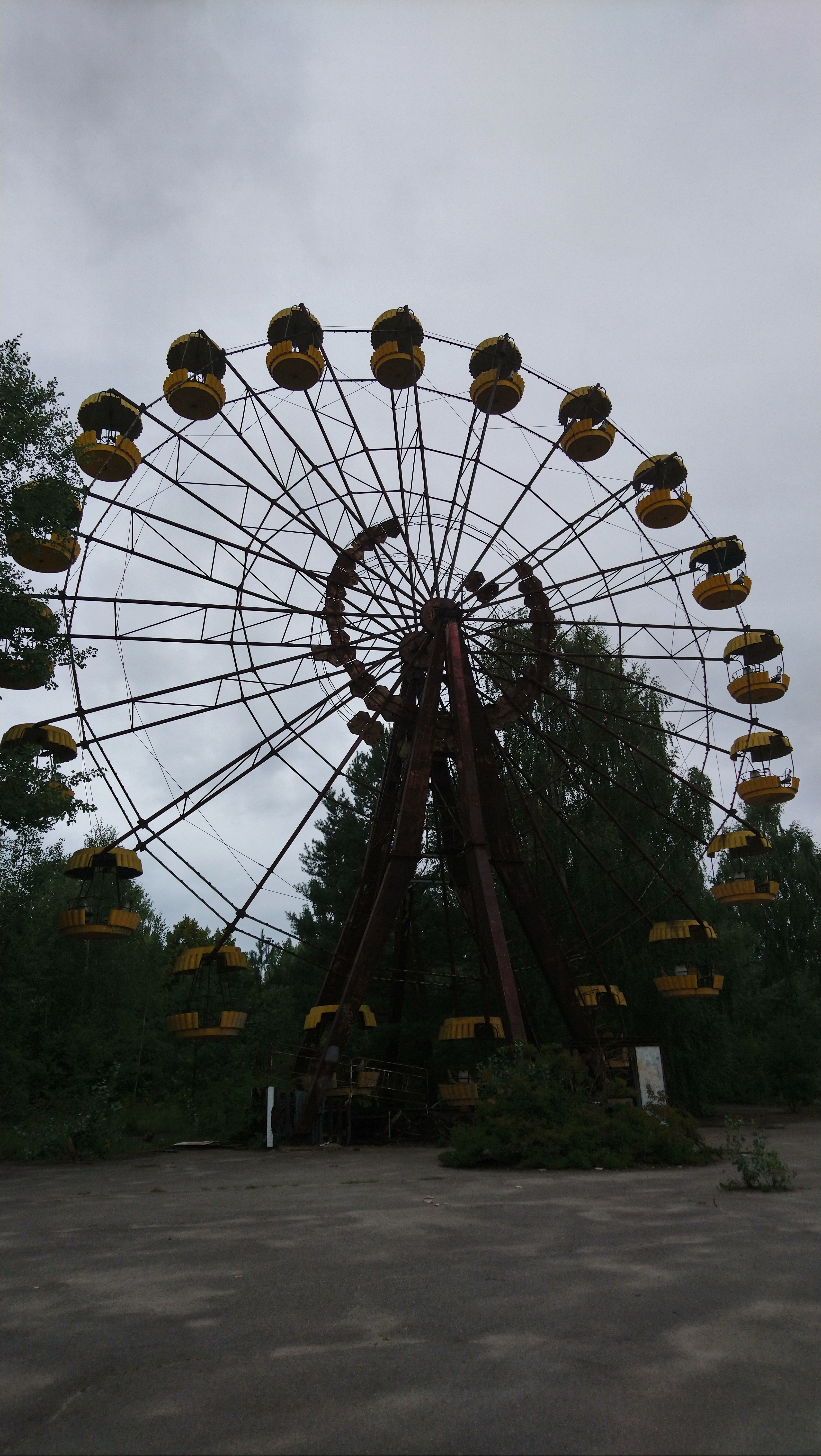 The stained glass window in the lakeside restaurant is still stunningly beautiful despite the decay. The elegant motif adorning the theatre’s façade hints at the grandeur that once was. The typically masculine, garish statue outside the administration building stands as if in defiance of time. The deserted dock, its boats long vanished, was surrounded by water in which no one would dare to dip a toe.
A gymnasium without gymnasts. A lone piano was abandoned on the stage of a crumbling auditorium. A swimming pool, its tiles falling away, its water long gone.
And then, the most haunting sight of all, the rusting carousel, its empty seats swaying gently in the breeze.

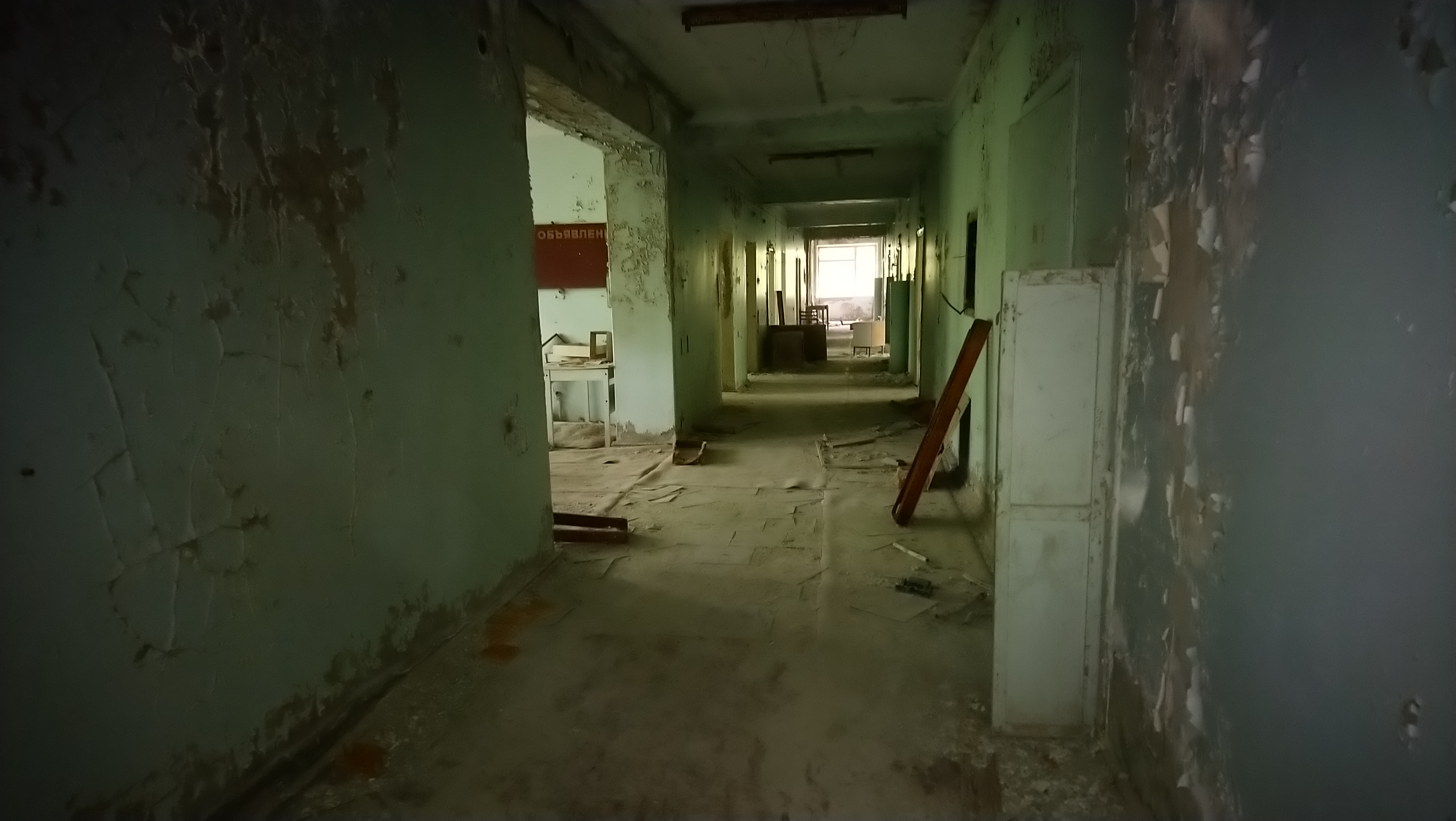

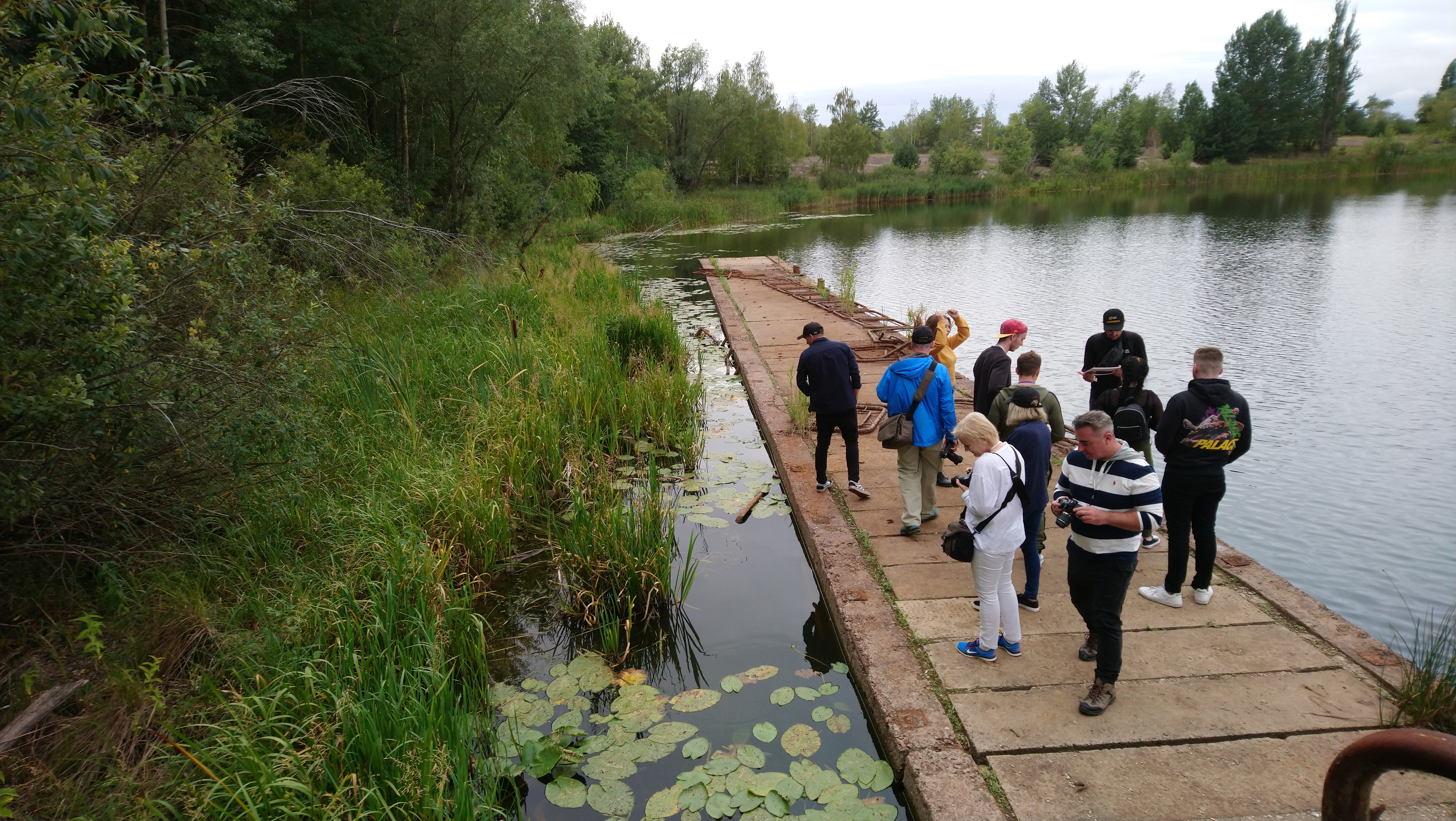

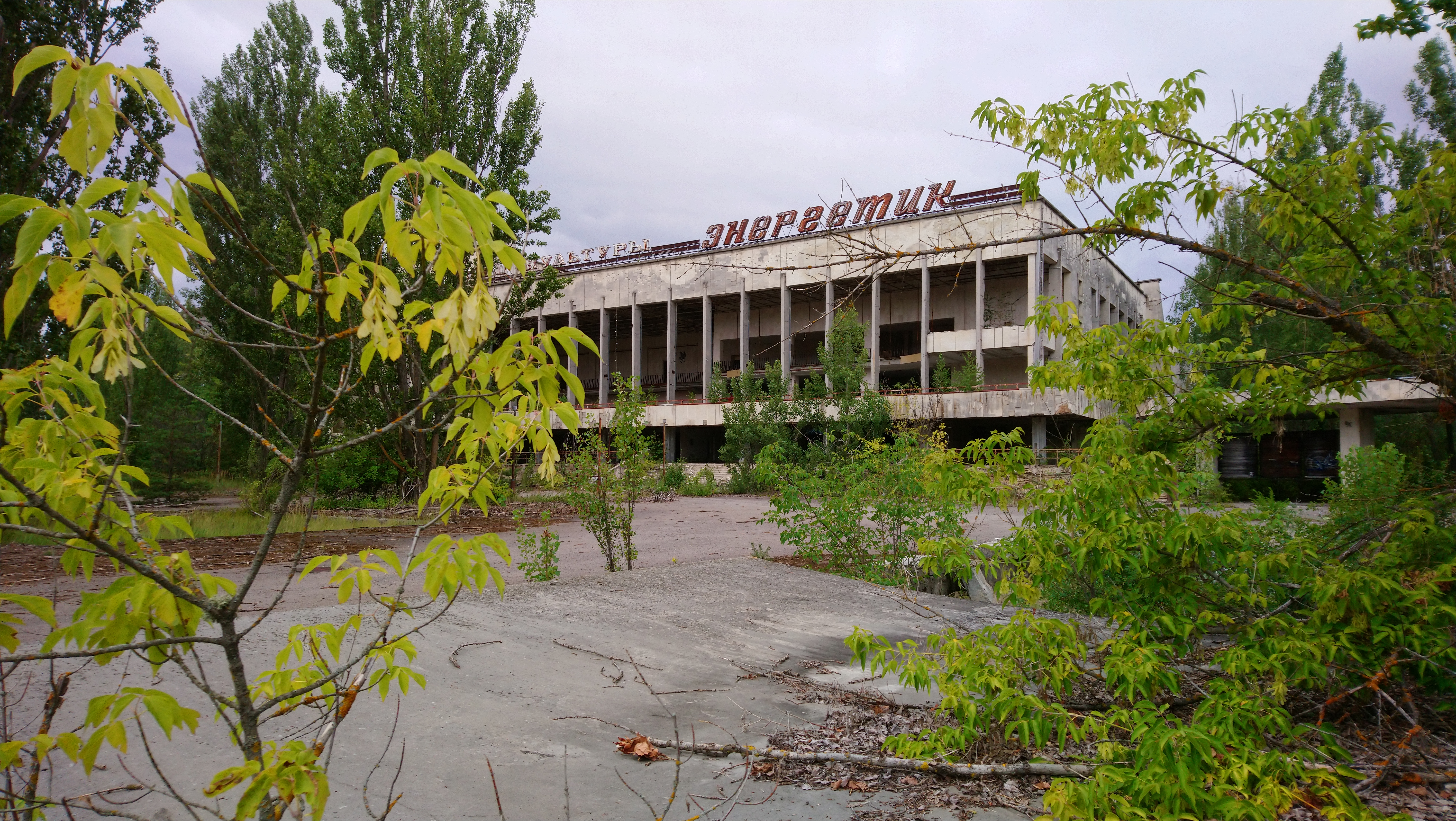


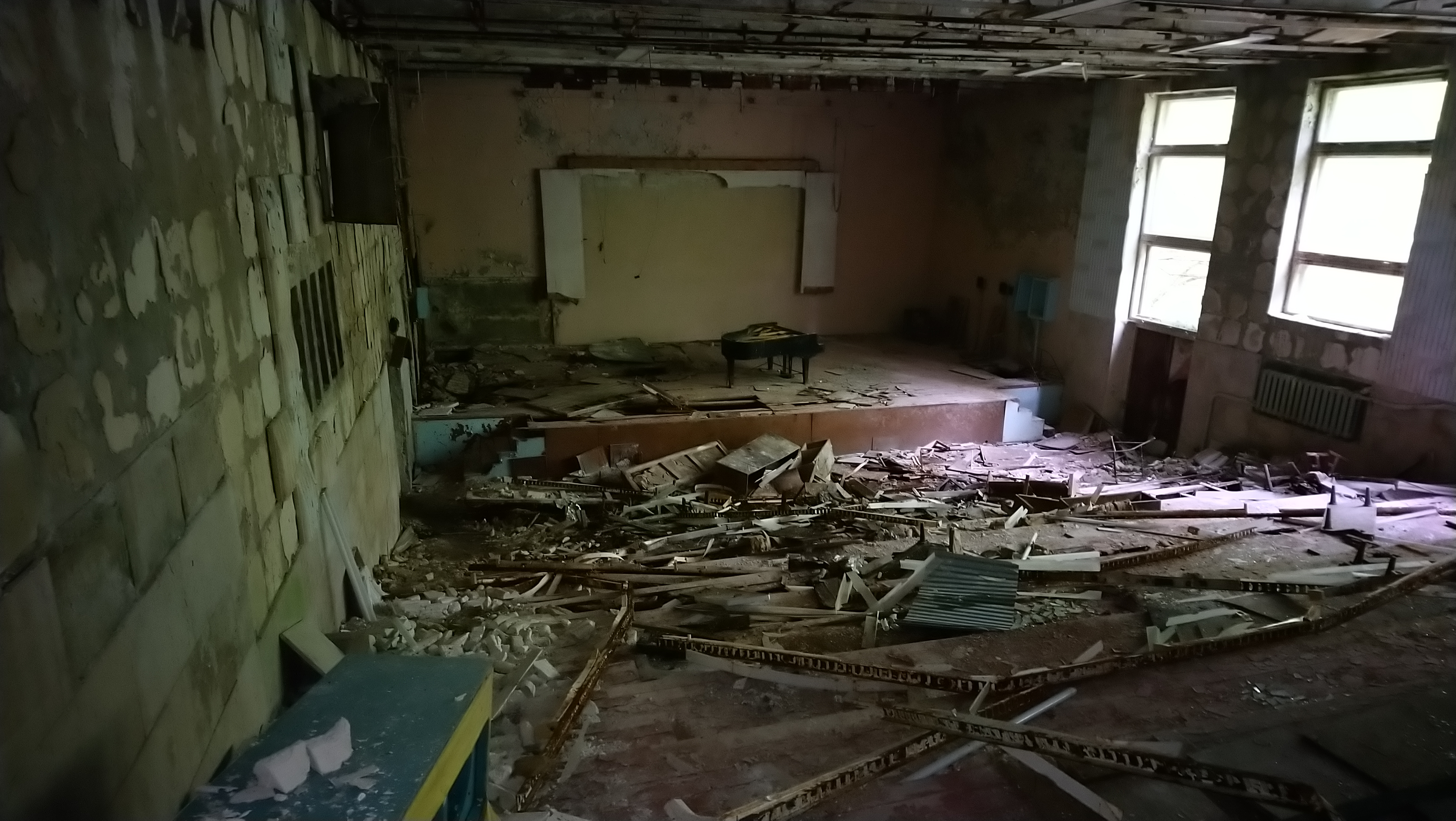
Each of us was undoubtedly moved by different locations, but for me, the most haunting moment came when I stepped into an abandoned classroom. Scattered desks, forgotten teaching materials, and a silence that spoke louder than any words. The children who once sat here would now be in their forties. I wasn’t sure I wanted to dwell on that thought. I took no photos. Some memories don’t need capturing; they imprint themselves on the soul.
Throughout the Exclusion Zone, hot spots of radiation linger. The best humanity could do was bury much of the contaminated equipment and even remove and entomb the very soil itself. And yet, despite these efforts, the problem remains unsolved. The sarcophagus sealing Reactor 1 is an international patchwork, an Italian-built roof, British bolts, and German insulation, but it is not a permanent fix. It will last 100 years. The gamble is that, by then, humanity will have discovered a way to deal with the disaster for good. The clock is ticking.
On our way back to the Safe Zone, as if we needed a final reminder of where we had been, Alex told us to press our Geiger counters to the minibus window as we passed the Red Forest. This was marshland three decades ago, but now it’s thick woodland. It took just a few minutes to drive through, yet in that short span, the meters jumped from 8 RADs to 1440 RADs. A sobering demonstration. Perhaps I’d have preferred a different route, or for the driver to put his foot down a little harder on the accelerator.

Our return to Kyiv was uneventful, marked by little conversation. I think we were all lost in our thoughts, processing what we had seen.
Back in the city, we were dropped off near the Dnipro Hotel, and Jamie and I decided to have a meal in Nezalezhnosti Maidan (Independence Square). The square was lively, with its statues, fountains, and a mix of locals and tourists enjoying the evening. We found a Turkish restaurant at the top of the square and had an excellent meal before finishing off the night watching a spectacular fountain display set to music. It was a beautiful, colourful contrast to the stark, haunting scenes of the day recently witnessed. Eventually, we caught a taxi back to the Adria and called it a night.
The next morning, we allowed ourselves a late start. After a leisurely coffee in the hotel bar, we took the Metro one stop to the Hydro Park. The Kyiv Metro is a marvel, efficient, cheap, and easy to use. For just 8 Hryvnia (26p), we received a small plastic token, which we slotted into the barrier before stepping onto the platform. Curiously, there seemed to be no enforcement mechanism; nothing physically prevented people from bypassing the system, but everyone paid regardless.
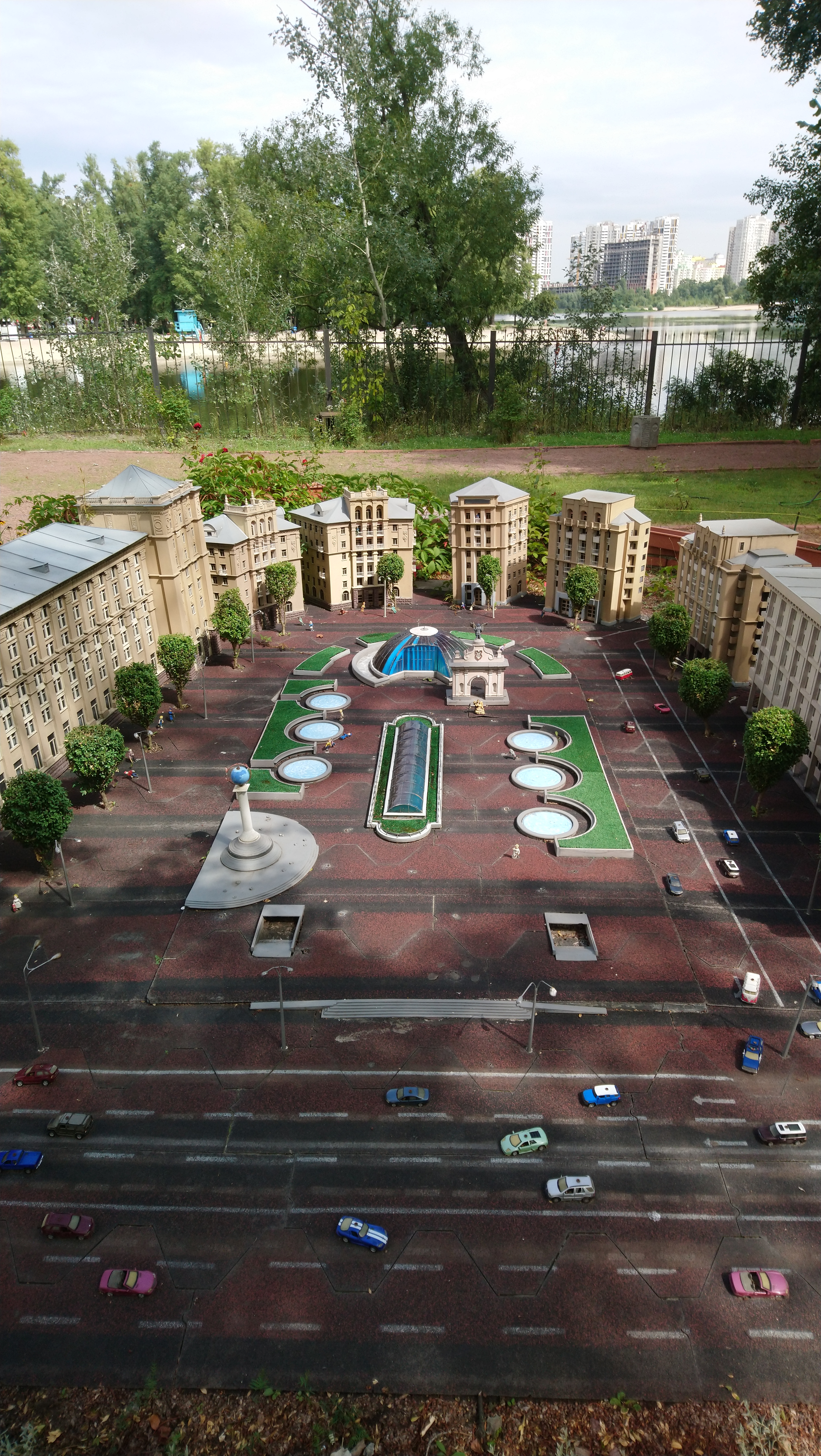
Hydro Park is a fantastic retreat for Kyiv’s residents, a large island in the middle of the Dnipro River featuring parks, a funfair, restaurants, museums, a beautiful beach, and plenty of water sports. Our first stop was breakfast at a small café near the entrance, followed by a visit to the Kiev in Miniature Museum. With this being our last full day in the city, it seemed fitting to see its landmarks in a more condensed and manageable way. The museum was inexpensive, and we found it an interesting way to spend an hour. After a short walk around the north side of the island, we hopped back on the Metro, this time heading to Dnipro Station, just one stop away, same price, same efficiency.

 From the station, it was a bit of an uphill trek to Kyiv-Pecherska Lavra, also known as the Kyiv Monastery of the Caves. This historic Orthodox Christian monastery is a striking sight, its many golden domes gleaming and visible from much of the city.
Our first stop was the monastery’s famed caves. Dark, narrow, whitewashed passages twisted away in all directions, each leading to a crypt containing several glass-topped coffins. If you purchased a candle, you could peer inside and see the splendidly robed inhabitant, presumably a past priest or abbot, resting in a preserved state. The flickering candlelight added to the eerie yet reverent atmosphere.
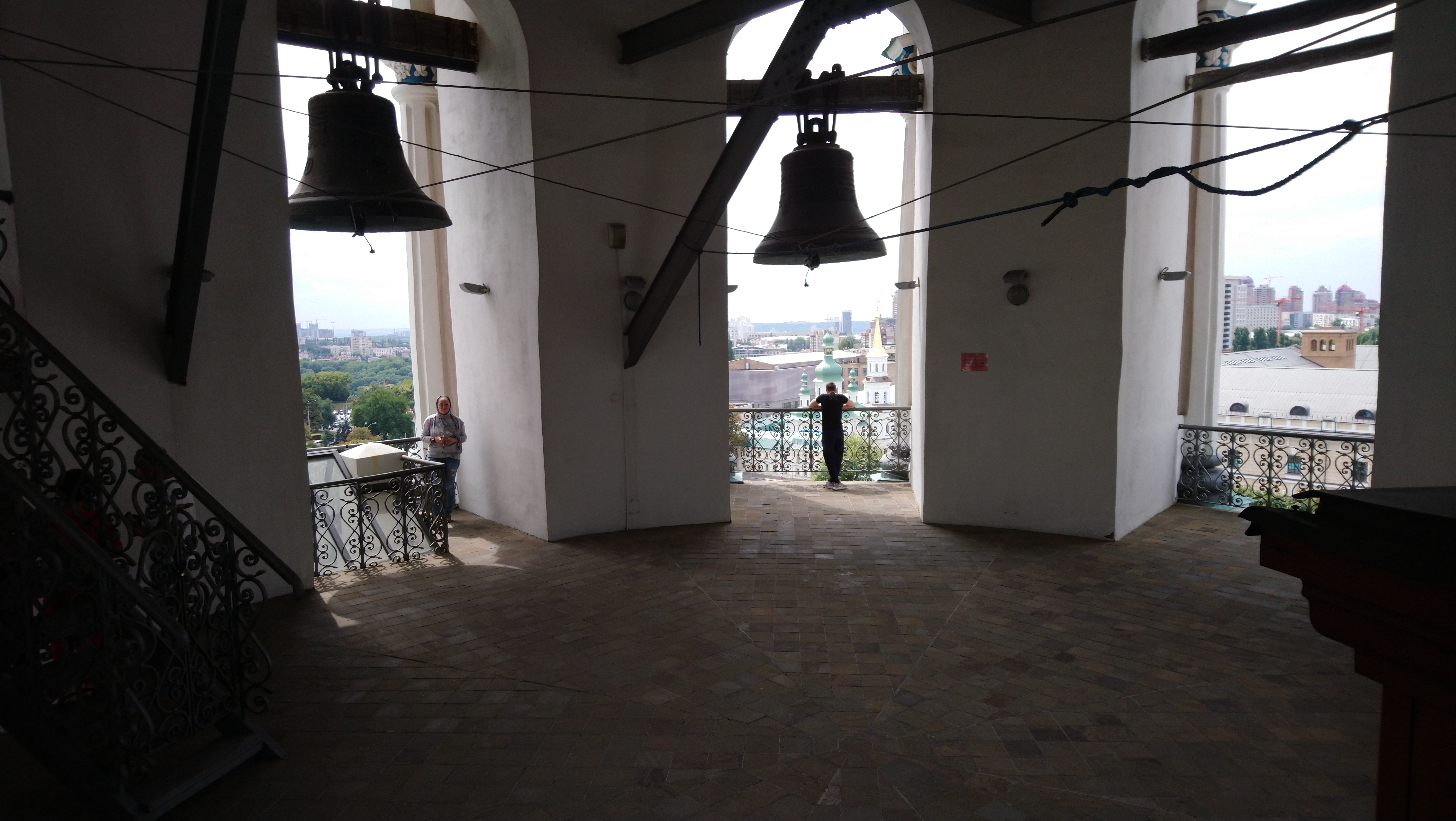
Next, we tackled the bell tower, drawn by the promise of panoramic views over the city and the Dnipro River. The climb, however, was not for the unfit, the faint-hearted, or anyone with a life-threatening medical condition! By the time we reached the top, both Jamie and I were completely shattered. But the view, stretching across Kyiv’s skyline, with the golden domes of the monastery shining below, made it all worthwhile.


Returning to ground level, we wandered out of the monastery complex toward the immense Rodina Mat (Motherland) statue, which dominates the Kyiv skyline.
On the way, we passed a striking display of military vehicles captured by the Ukrainian army during the Russian incursion of 2014/15. Each vehicle had an information board detailing its specifications and the battle in which it was seized. The damage to many of them suggested that their occupants had not survived. It was a stark reminder that Ukraine’s armed forces are no pushovers.
Amid the solemnity, Jamie and I couldn’t resist having a bit of fun in an attack helicopter bristling with weaponry. For just 10 Hryvnia each, we climbed into the cockpit and took turns “firing” the front-mounted machine gun. It was great fun, though a single bullet hole in the corner of the windscreen caught my attention. Perhaps the pilot had been shot, yet still managed to land the aircraft intact. I couldn’t help but wonder what became of him.


The Motherland statue is undeniably spectacular. Jamie compared it to Christ the Redeemer, and while I saw his point, the surrounding scenery lacked the same iconic grandeur. Unlike Christ the Redeemer, which emerges dramatically from the Rio skyline, the Motherland statue is visible from miles away, so by the time you stand at her feet, there are no surprises.
After a brief visit, we decided to move on, satisfied that we had paid our respects to one of Kyiv’s most imposing landmarks.
 Feeling hungry, we found a small restaurant near the monastery and spent a leisurely hour soaking up the afternoon sun while enjoying a delicious meal.
We had intended to return to Dnipro Station via a shortcut that led down a steep, wooded incline. However, due to extensive construction work in the area, we found ourselves unable to reach the station, despite being just 50 metres away. Frustratingly, we had no choice but to climb back up the slope and take the long way around.
From the station, we made our way back to Hydro Park, where we headed down to the beach and boarded a small cruiser for a one-hour trip along the river, costing 120 Hryvnia.
Three boats were moored at the quay: one offering a four-hour journey, another a two-hour trip, and ours. Each departed within minutes of the other, setting off in different directions. 
 The weather had been glorious all day, but just as we left, the heavens opened, forcing us to abandon our prime spot on the top deck and retreat inside. We were soon joined by other passengers seeking shelter. Fortunately, the storm lasted only 15 minutes before the sun re-emerged. I treated myself to a beer, which, at just 40 Hryvnia, was the cheapest drink I’d had so far! If only Cunard had the same pricing policy.
 After steaming downstream for a while, we turned about and, sailing past our departure point, continued upstream towards the Motherland Statue before eventually returning to our berth on the hour. It was a relaxing way to take in the sights of Kyiv, with the added thrill of a brief storm.
We took the Metro back to the hotel and opted for an Irish bar for our evening meal and entertainment.
 The following morning, we had breakfast at a Ukrainian fast-food outlet on the other side of the roundabout. It was extremely popular and incredibly cheap. You simply picked a number from a picture on your tray’s placemat, and they served you a similar plate of food. The quality was nothing special, basic fast food, but it filled the stomach and stayed down, so it couldn’t have been that bad!
As we got into our taxi to the airport, Jamie had a brief moment of panic, convinced he had lost his wallet. After a frantic search through his bag, I found it, right where he had already looked. Crisis averted, we arrived at Boryspil Airport with plenty of time to check in and enjoy lunch before our flight.

We were separated again on the flight back, but, as before, each of us had a spare seat beside us, allowing us to stretch out and get some sleep. The journey back to Harborough was smooth and uneventful.


Leave a Reply